Assistant Professor · Department of Mathematics · University of Oklahoma
My name is Weinan Wang and I am a tenure-track Assistant Professor in the Department of Mathematics at the University of Oklahoma. I obtained my PhD in Applied Math from the University of Southern California (USC) under the supervision of Igor Kukavica in August 2020. After that, I worked as a postdoctoral fellow at the MSRI and a postdoctoral associate at the University of Arizona mentored by Christopher Henderson. In summer 2023, I was a MSRI research member.
IAS Summer Collaborators AwardInstitute for Advanced Study, Princeton, 2024
MSRI Research MemberMathematical Sciences Research Institute, Berkeley, 2023
MSRI Postdoctoral FellowshipMathematical Sciences Research Institute, Berkeley, 2021
Edward and Dolores Blum Graduate Research PrizeUniversity of Southern California, 2020
Departmental FellowshipUniversity of Southern California, 2019
Research
Operator Learning · AI for Mathematics · PDEs
Research Interests
Applied mathematics; operator learning; AI for Math; scientific AI agent design; Lean formalization; data science; applied optimal transport; Bayesian inverse problems; fluid and kinetic models; mathematical biology/biostatistics; uncertainty quantification; applied probability and statistics; machine learning in scientific computing; optimal control; stochastic processes
Research Overview
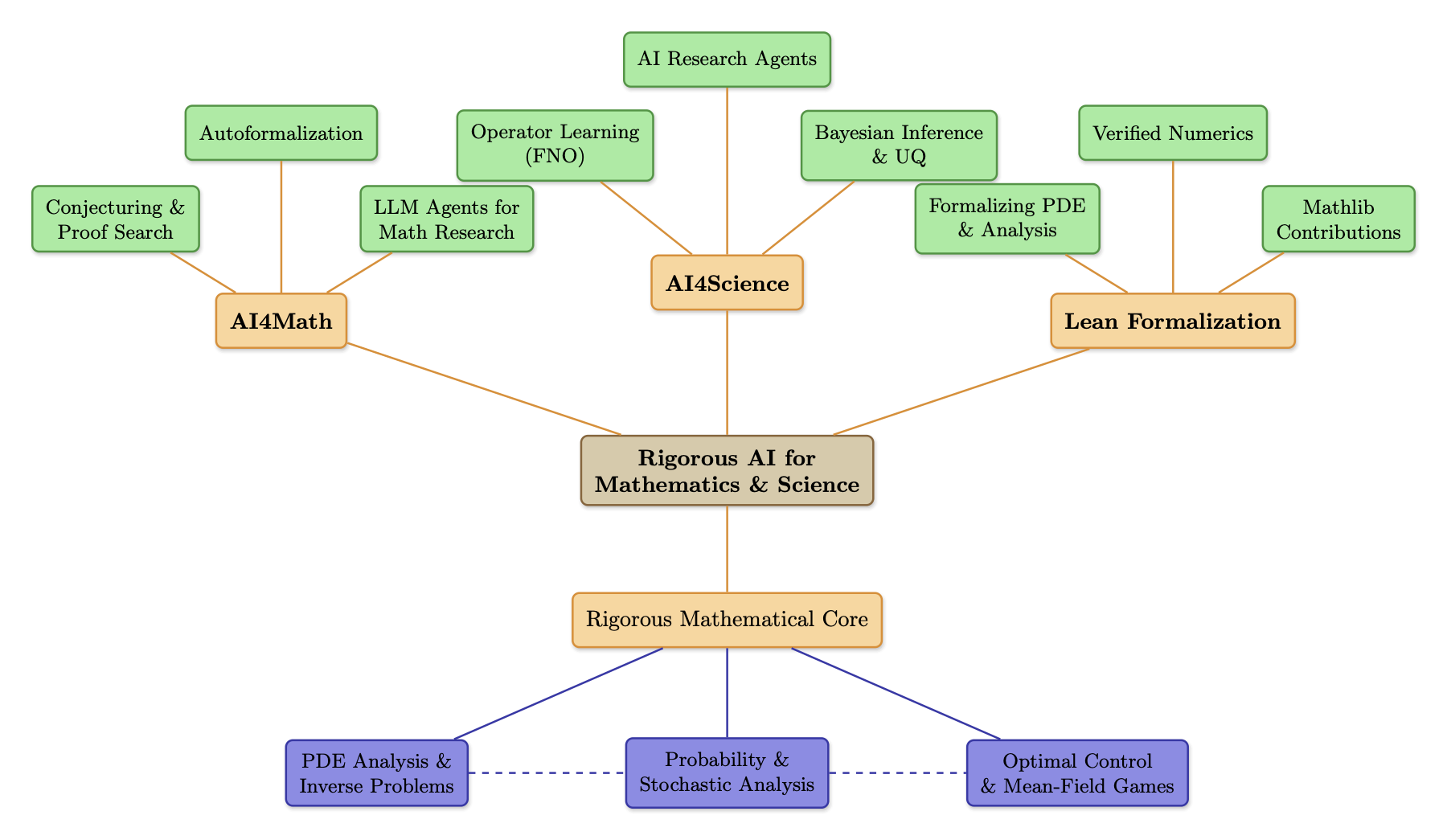
A schematic view of my research program: AI4Math, AI4Science, and Lean formalization built on a rigorous mathematical core in PDE analysis, inverse problems, stochastic analysis, mathematical biology and modeling, optimal control, and mean-field games.
Operator Learning, AI-for-Math, AI, & Formalized Math
AI Research Infrastructure.
I design, evaluate, and deploy AI systems for mathematical research — domain-specialized language models, autonomous research AI agents, agent RL for reward-trained ranking, and interactive scientific simulations. My newest direction is multi-agent system (MAS) design: small specialist agents hand work to one another, critique intermediate outputs, and expose their conversation so users can see how a statistical or numerical analysis is assembled.
Interactive Lab Banner
Interactive Cloth LabWeinan Wang AI Lab
-- FPS-- PTS
WebGL2 is not available in this browser. The cloth renderer needs WebGL2 for the lit 3D flag.
Large Language Models (LLMs) for Research
Domain-specialized language models developed by Weinan Wang (2025-present), fine-tuned for technical research across mathematical biology, applied mathematics, operations research, and optimal control. Unlike general-purpose chatbots, these models are trained to reason with research-level terminology, notation, and technical depth.
Fine-tuned Qwen2.5-Math-7B for operations research and optimal control. Formulates, solves, and explains LP/IP, network flow, inventory, queuing, and LQR problems.
RESEARCH GRADEMathBio AI (72B)
Larger model trained on the OU Schooner supercomputer. Achieves 0.738 overall on the math-bio benchmark. Evaluation release in progress.
A formal-mathematics AI track developed by Weinan Wang (2025-present), connecting domain-specialized LLM reasoning with Lean 4 verification. The project is designed for translating research mathematics into Lean statements, drafting proof skeletons, debugging proof states, and building reusable formalization workflows for PDEs, operator learning, and mathematical biology.
LEANPILOT AILeanPilot AI Assistant
Developed by Weinan Wang as an LLM assistant for theorem formalization, Lean 4 statement drafting, proof-state interpretation, and Mathlib-aware proof repair.
A Lean 4 research platform developed by Weinan Wang (2025-present) for tracing inverse-problem arguments through machine-checked proof routes. The public interface includes landmark-paper dossiers, source-ordered mathematical stages, and clear distinctions among verified results, analytic inputs, and open bridges.
LEAN 4Inverse Problems Research Lab
Explore classical Calderón, Sylvester–Uhlmann, Alessandrini, and Mandache proof routes together with the Li–Wang and Liu–Wang formalization dossiers.
I develop agentic AI and AI-enhanced scientific-computing tools that help researchers model, analyze, and better understand complex physical and biological systems. By connecting mathematical reasoning with numerical simulation, data analysis, and reproducible workflows, these tools are designed to accelerate scientific discovery while keeping assumptions, diagnostics, and human judgment visible.
Math Research AI Agent (by Weinan Wang, 2026-present) — AI research assistant that turns a mathematician's arXiv record into a structured map of papers, themes, reading paths, first steps, and possible project directions.
Open Math Research AI Agent
Google Scholar AI Agent (by Weinan Wang, 2026-present) — Citation and literature radar that works from Google Scholar alert files, research interests, and paper metadata to rank scholarly items and produce citation-quality briefings.
Open Google Scholar AI Agent
arXiv AI Agent (by Weinan Wang, 2026-present) — Interactive arXiv AI agent for exploring recent papers by research interests, keywords, and arXiv categories, with an RL-trained paper-ranking component trained from research-memory reward signals.
Open arXiv AI Agent
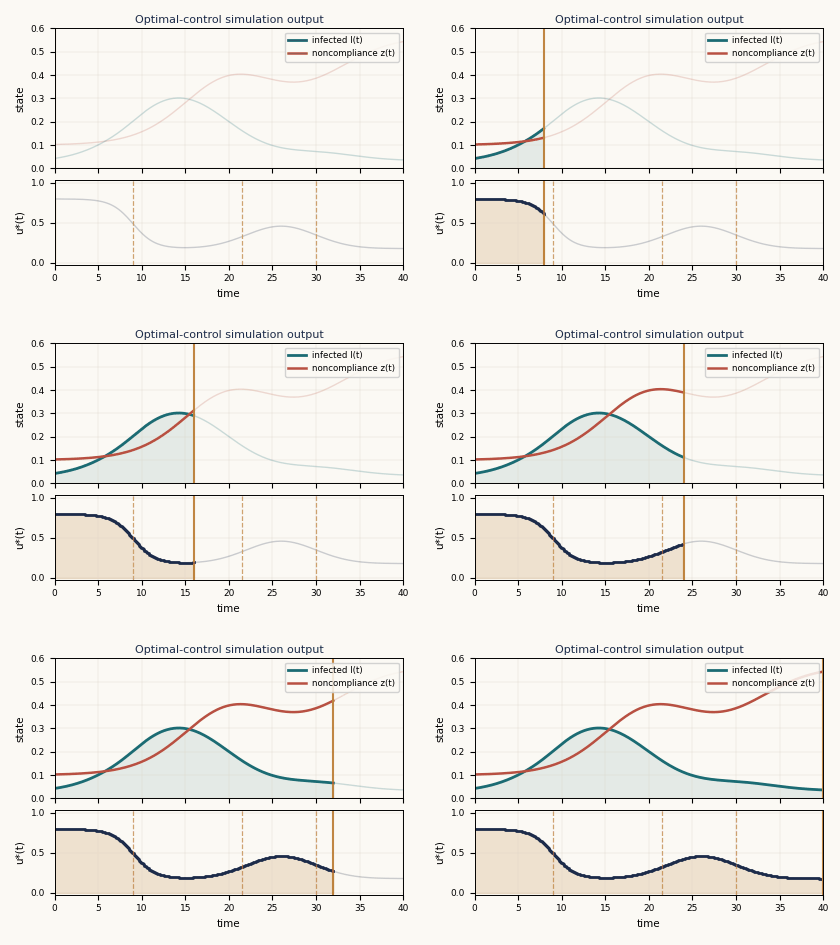
AI for Math Biology (by Weinan Wang, 2026-present) — LLM-powered research AI agent for ODE/SDE/PDE epidemic models with real-time parameter estimation, stochastic simulation, and optimal control.
MathBio AI Agent
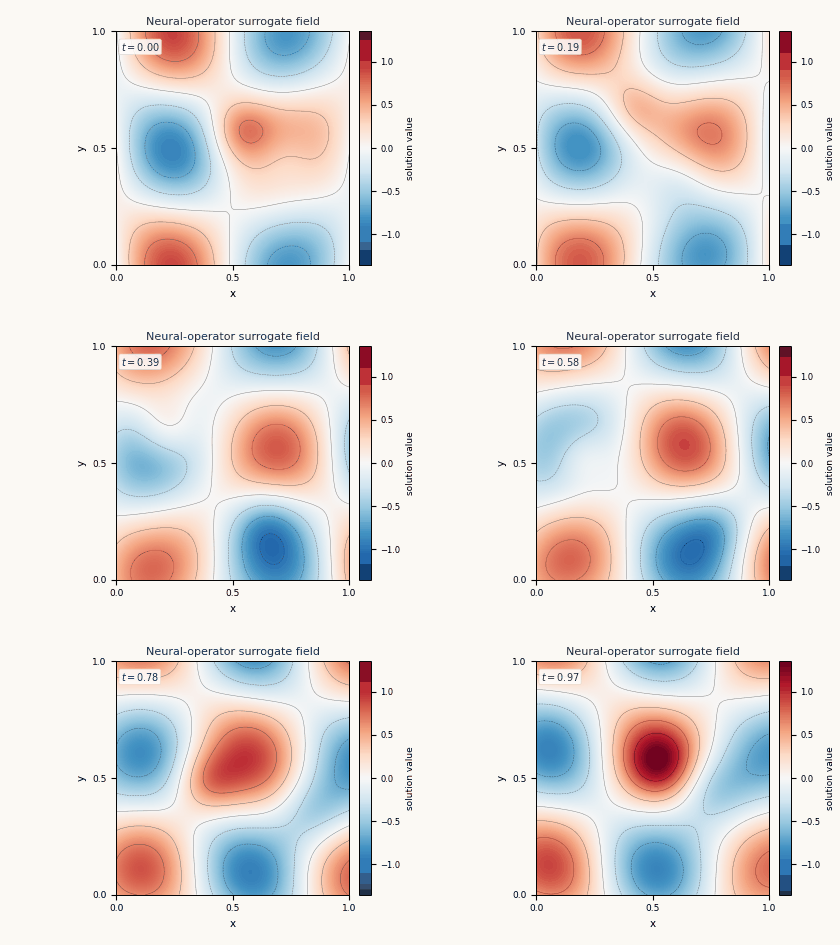
AI for Fluid Dynamics & Weather (by Weinan Wang, 2025-present) — Neural surrogate training (Fourier Neural Operator), automated regime discovery, and LLM experiment planning over a real-time fluid dynamics solver with the National Weather Center (Norman, OK) data integration.
Fluid&Weather AI Agent
AI for Human Behavior in Epidemics (by Weinan Wang, 2025-present) — Agent-based simulation comparing 6 behavioral adaptation mechanisms (prevalence-dependent, media/awareness, game-theoretic, policy threshold, fatigue).
HumanBehavior AI Agent
Multi-Agent System
These systems are built as a connected scientific AI ecosystem, not separate chat boxes. Each run follows a shared protocol — question, assumptions, method choice, Python/R/MATLAB code, diagnostics, critique, and final memo — while specialized agents exchange artifacts, relay packets, judge scores, and human-gated memory candidates across statistics, numerical analysis, decision optimization, and self-improvement.
AI for Statistics
From messy data to statistical memo
Data-Cleaning, Statistician, Visualization, and Report agents talk through dataset quality, variable roles, assumptions, model choice, plots, Python/R/MATLAB drafts, and cautious interpretation. The shared engine adds judge scores, staged memory, and relay packets for numerical-analysis or decision-model follow-up.
Shared protocolPython + R + MATLABStats-numerics relay
Designed and developed by Weinan Wang.
Shared Protocoldata, code, plots, memo
Data-Cleaningaudit + repair
diagnostics
Statisticianassumptions + model
model brief
Visualizationplots + patterns
figure notes
Reportmemo + code
revision
Agent conversation: each robot sends an artifact into the shared workspace, then receives critique from the next specialist.
Conversation replay
Data-Cleaning:Dataset audit complete: missingness and variable types are documented.
Agent conversation: the orbit makes the feedback loop visible: formulation shapes the method, stability constrains code, and benchmarks push revisions back into the lab.
Conversation replay
Classifier:Classified as a parabolic PDE with mixed boundary data.
Gateway, Formulator, Constraint Modeler, Method Selector, Solver Architect, Verifier, Simulation, Visualization, and Decision Memo agents coordinate states, controls, constraints, solver choices, Python/R/MATLAB drafts, feasibility checks, trajectories, and a cautious recommendation under the same shared protocol.
Shared protocolPython + R + MATLABDecision handoffs
Designed and developed by Weinan Wang.
Decision Labmodel, solver, audit, memo
Gatewayproblem route
Formulatorstates + controls
MethodLP/MILP/MPC
Solvercode artifacts
Verifierfeasibility
Simulationstress path
Visualizationplots + slack
Memooperating plan
scopemodelmethodcodeauditstressfiguresmemo
Decision conversation: optimization agents pass a structured plan around the orbit, so constraints, solver code, feasibility, simulation, and the final memo can critique one another before the recommendation lands.
Conversation replay
Gateway:Routed the request to a constrained dynamic-control workflow.
An OpenClaw-style gateway, Hermes-compatible backend lane, critic, benchmark, and memory agents turn each scientific answer into a scored revision loop for statistics, numerical analysis, and optimal-control/OR tasks. The export bundle includes Python/R/MATLAB adapter sketches, staged memory, and a human approval gate before promotion.
Shared protocolHuman approval gatePython + R + MATLAB
Designed and developed by Weinan Wang.
Learning Loopanswer, critique, score, memory
GatewayOpenClaw-style route
route
ReasonerHermes lane
draft
Criticflags + fixes
critique
Benchmarkscore + gate
score
Memorylessons kept
lesson
Reportnext-run plan
Self-improvement loop: the first answer is not the endpoint; critics, benchmarks, and memory convert it into a more disciplined next run.
Conversation replay
Gateway:Routed the scientific request and attached the prior run context.
An OU Mathematics advising system that turns the 2026-2027 catalog into a deterministic degree audit, prerequisite check, next-course planner, and cited agent handoff.
Pilot scope: Mathematics B.A. Standard Option and B.S. Professional Option.
Advising model: public catalog data first, AI explanations second, human advisor handoff when policy risk appears.
Status: Hugging Face testing deployment for early OU Math experiments.
Math 1914Differential and Integral Calculus IFall 2026
Math 4163Introduction to PDEsSpring 2026
Math 3990Independent StudySpring 2026
Math 3440Mentored Research ExperienceSpring 2026
Math 3423Physical Mathematics IIFall 2025
Math 3980Honors ResearchFall 2025
Math 3440Mentored Research ExperienceSummer 2025
Math 2924Differential and Integral Calculus IISpring 2025
Math 3980Honors ResearchSpring 2025
Math 4433Introduction to Analysis IFall 2024
Math 2934Differential and Integral Calculus III (Honors)Fall 2024
Math 4073Numerical Analysis ISpring 2024
Math 2934Differential and Integral Calculus IIISpring 2024
Math 2443Calculus and Analytic Geometry IVFall 2023
Service & Outreach
Conferences, committees, reviewing, and community engagement
Conferences & Seminars
Organizer, Special Session on Recent Trends in Differential Equations and Optimal Control with Biological Applications, JMM, Chicago, IL, Jan. 12–15, 2027
Organizer, Special Session on Recent Developments in PDEs and Inverse Problems, JMM, Washington DC, Jan. 2026
Reviewer for zbMATH and Mathematical Reviews / MathSciNet. Journal reviewer for:
Advanced Nonlinear Studies
Annals of Applied Statistics (AOAS)
Communications in Statistics - Theory and Methods
Communications on Pure and Applied Analysis
Discrete and Continuous Dynamical Systems-B
Journal of Differential Equations
Journal of Functional Analysis
Journal of Mathematical Analysis & Applications
Journal of Mathematical Fluid Mechanics
Journal of Mathematical Physics
Journal of Nonlinear Science
Mathematical Biosciences
Mathematical Biosciences and Engineering
Networks and Heterogeneous Media
Nonlinearity
Physics of Fluids
Potential Analysis
Risk Analysis
SIAM Journal on Mathematical Analysis
Zeitschrift für Angewandte Mathematik und Physik
Committees
2026–2027 Department of Mathematics, University of Oklahoma
Newsletter Committee (Chair)
RFRA/Strategic Planning Committee
Interdisciplinary Committee
2025–2026 Department of Mathematics, University of Oklahoma
Undergraduate Awards Committee
First Year Math Committee
OU Math Day Committee
Undergraduate Committee
Newsletter Committee
2024–2025 Department of Mathematics, University of Oklahoma
OU Math Day Committee
Undergraduate Committee
Syllabi Preparation Committee
Newsletter Committee
2023–2024 Department of Mathematics, University of Oklahoma
Undergraduate Committee
Syllabi Preparation Committee
Newsletter Committee
2022–2023 Department of Mathematics, University of Arizona
Undergraduate Committee
Undergraduate Awards and Scholarship Sub-Committee
Teaching Representative of the Postdoc Committee
2021–2022 Department of Mathematics, University of Arizona
Undergraduate Committee
Undergraduate Awards and Scholarship Sub-Committee
Teaching Representative of the Postdoc Committee
Outreach
Math Alliance mentor for doctoral and pre-doctoral students, Fall 2023–present
Nov 6, 2025 — Co-organized OU Math Day for over 300 high school students.
Apr 22, 2025 — Shared research on applications of differential equations at the OU Math Club.
Nov 7, 2024 — Co-organized OU Math Day for over 400 high school students.
Spring 2023 — Mentored five students on "Non-pharmaceutical Interventions for Disease Spread Mitigation" in Math 485 at UArizona.
Early Career Math Colloquium
Organizers: Rongchang Liu, Christian Parkinson, and Weinan Wang
Goal: To provide junior mathematicians (graduate students, postdocs, assistant professors), especially those from underrepresented groups, with an opportunity to showcase their research. All talks are recorded (with permission) and available on YouTube.
Dec 4 Antonio Agresti (Delft University of Technology)
Spring 2023
Wednesdays, 2:30–3:30pm Arizona time
Feb 1 Yuzhe Zhu (University of Cambridge)
Feb 8 Sarah Strikwerda (NC State University)
Feb 15 Elliot Cartee (University of Chicago)
Mar 1 Michael Lindstrom (UT Rio Grande Valley)
Mar 15 Yotam Yaniv (UCLA)
Mar 22 Quyuan Lin (UC Santa Barbara)
Mar 29 Mengxuan Yang (UC Berkeley)
Apr 5 Katherine Zhiyuan Zhang (Courant Institute, NYU)
Apr 12 Xueying Yu (University of Washington)
Apr 19 Lucio Galeati (EPFL, Switzerland)
Apr 26 Brennan Sprinkle (Colorado School of Mines)
May 3 Khoa Le (University of Leeds)
Fall 2022
Organizers: Christian Parkinson and Weinan Wang · Wednesdays, 2:30–3:30pm Arizona time
Sep 7 Austin Christian (Georgia Institute of Technology)
Sep 14 Fizay-Noah Lee (Princeton University)
Sep 21 Samy Wu Fung (Colorado School of Mines)
Oct 12 Marcelo Bongarti (Weierstrass Institute, Germany)
Oct 19 Evan Miller (University of British Columbia)
Oct 26 Hanye Zhu (Brown University)
Nov 2 Jake Brusca (New Jersey Institute of Technology)
Nov 9 Kevin Miller (Oden Institute, UT Austin)
Nov 16 Federico Pasqualotto (Duke University)
Nov 23 Havva Yoldış (Delft University of Technology)
Nov 30 Wen Feng (Niagara University)
Spring 2022
Organizers: Ethan O'Brien and Weinan Wang · Fridays, 12:00–1:00pm Arizona time
Feb 11 Trinh Nguyen (USC)
Feb 25 Stan Palasek (UCLA)
Mar 18 Doug Pfeffer (Berry College)
Mar 25 Jaemin Park (University of Barcelona)
Apr 1 Guher Camliyurt (University of Chicago)
Apr 8 Elie Abdo (Temple University)
Apr 15 Alison Mirin (University of Arizona)
Apr 22 Renato Velozo Ruiz (University of Cambridge)
Computational Labs & Software
Interactive scientific labs and research software from the Wang Lab
Interactive Research Labs
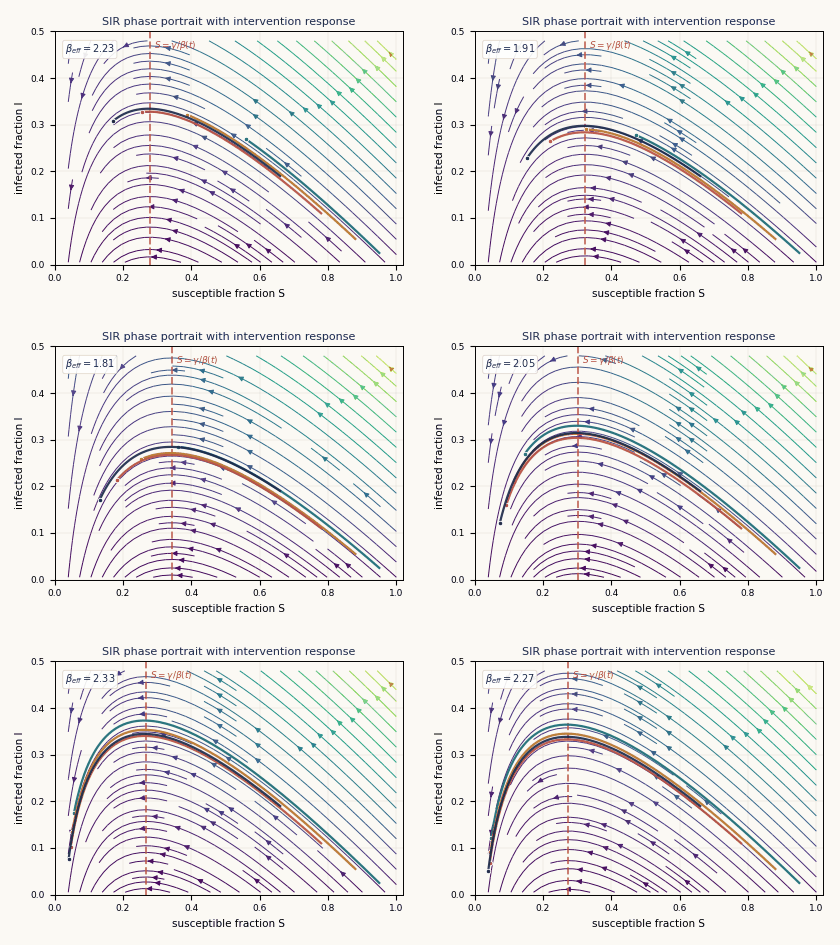
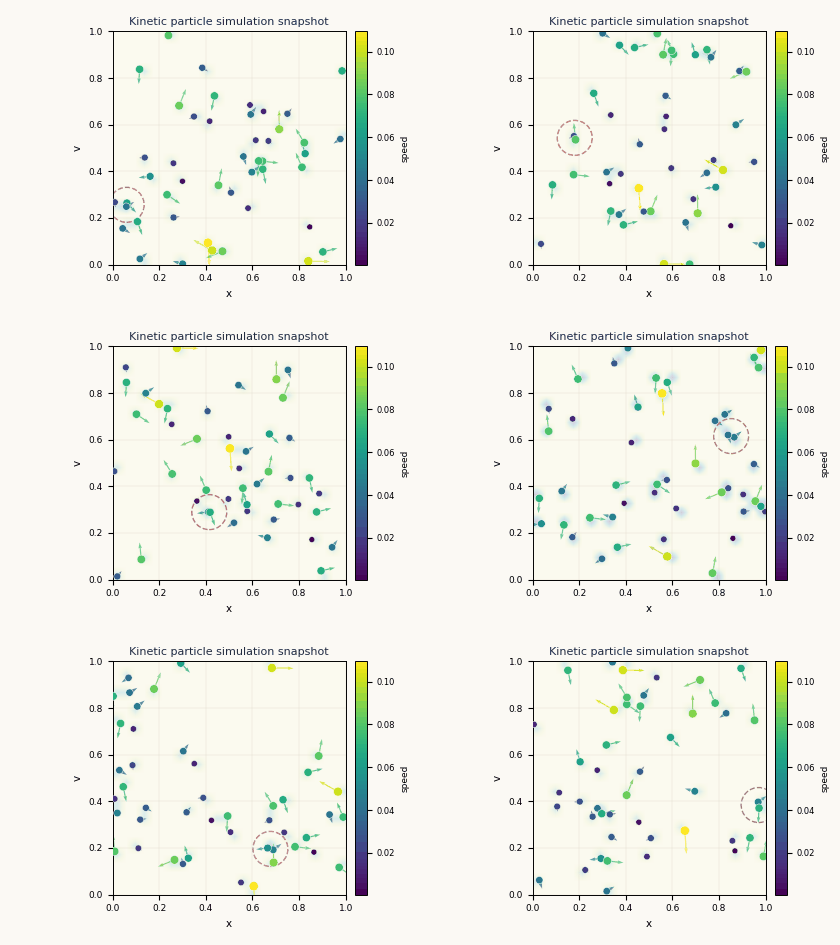
Interactive research demos for inverse problems, epidemic dynamics, incompressible fluids, and kinetic particle models.
Inverse Problems Lab
Epidemic Flow Field
Fluid Dynamics Lab
Kinetic Equation Lab
R Packages on CRAN
seairmobility: Mobility-Based SEAIR Epidemic Models (Weinan Wang, 2026) —
Tools for simulating, analysing, and fitting mobility-based SEAIR compartmental epidemic models
with heterogeneous individual mobility. Provides a numerical PDE solver, closed-form computation of
the basic reproduction number R0 and final epidemic size, and a least-squares routine for
recovering the mobility distribution from observed aggregate symptomatic time series.
Version 0.1.0 · Published 2026-04-28 · License: MIT ·
DOI: 10.32614/CRAN.package.seairmobility
npfseir: Nested Particle Filter for Stochastic SEIR Epidemic Models (Weinan Wang, 2026) —
Provides online Bayesian inference for stochastic SEIR epidemic models with time-varying transmission.
Uses a nested particle filter for joint state and parameter estimation, with utilities for simulation,
posterior summarisation, and forecasting.
Version 0.2.1 · Published 2026-04-24 · License: MIT ·
DOI: 10.32614/CRAN.package.npfseir
seirMFG: Mean-Field Game Equilibrium for SEIR Epidemics on Networks (Weinan Wang, 2026) —
Implements the forward-backward sweep algorithm for computing Nash equilibrium contact policies
in SEIR epidemic mean-field games on heterogeneous contact networks.
Supports heterogeneous networks with susceptible contact effort, value functions,
epidemic trajectories, and the effective reproduction number Rt.
Version 0.1.0 · Published 2026-04-09 · License: MIT ·
DOI: 10.32614/CRAN.package.seirMFG
Undergraduate Research · Postdoctoral Mentoring · Collaborative Projects
Mentoring Philosophy
My group works at the intersection of operator learning, applied PDEs, AI for mathematics, AI-guided discovery, AI-driven scientific computing, inverse problems, statistics/biostatistics, mathematical biology, stochastic processes, and optimal control. Students at every level — first‑year undergraduates through postdoctoral fellows — take on projects that combine mathematical modeling, rigorous analysis, scientific computation, and clear research writing.
Each project is shaped to the student's background and interests. I try to keep the questions concrete enough to make progress on in a semester, and open enough that the work can grow into a poster, a thesis, or a paper. We meet weekly, read together, code together, and write together.
ModelingTranslating questions in biology, epidemiology, and the sciences into PDE / ODE / stochastic models.
AnalysisStability, well‑posedness, regularity, and optimal control of the resulting equations.
ComputationNumerical schemes, operator learning, and data‑driven inference in Python and R.
CommunicationWriting, figure‑making, and presenting at undergraduate research symposia and beyond.
Next position: Graduate school in the Economics program at Duke University.
Mathematical Biology · Behavior
Data‑driven epidemic modeling with human behavior
Anubhab Ganguly
Epidemic models in which compliance, awareness, and contact behavior are coupled to the disease dynamics, calibrated against outbreak data.
ODE / PDE modelingData calibrationPython
AI-for-Math · Machine Learning
AI-for-Math and machine learning
Petr Groshenko
Research on machine-learning methods for mathematical reasoning, formalization workflows, and computational tools for research mathematics.
AI-for-MathMachine learningMathematical reasoning
AI4Science · Mathematical Biology · LLM Ranking
AI-assisted tumor-growth law discovery
Victor Lu
Symbolic regression, mathematical admissibility checks, classical and PINN coefficient refitting, and LLM-based model ranking for recovering tumor-growth laws from sparse data.
Independent Study and Honors Research, partially supported by the Junior Faculty Fellowship, OU. Data‑driven epidemic modeling that couples disease dynamics with human behavior.
Fall 2024 – Fall 2025
Chloe NgoUndergraduate
HRAP, OU. Co‑mentored with Christian Parkinson. Optimal control of epidemic disease via the Pontryagin maximum principle.
Next position: Graduate school in the Economics program at Duke University.
Summer 2025
Laila RuslanUndergraduate
Summer Research Assistant, OU. Network analysis in epidemic disease modeling.
Spring 2025
Ava CiminiUndergraduate
HRAP, OU. Optimal control of the SIR model.
Spring 2022
Nathan GomezUndergraduate
Undergraduate Teaching Assistant Program, University of Arizona.
Spring 2022
Lenox BaloglouUndergraduate
Undergraduate Teaching Assistant Program, University of Arizona.
Fall 2021
Jack HallUndergraduate
Undergraduate Teaching Assistant Program, University of Arizona.
For Students Interested in Joining
Get in touch.
I am happy to talk with OU undergraduates and graduate students who would like to work on a research project — through HRAP, an Independent Study, an honors thesis, or a summer assistantship. Visiting and remotely co‑advised students are also welcome when there is a clear scientific overlap.
The best first step is a short email (ww@ou.edu) describing the courses you have taken, what you have enjoyed in them, and a few sentences about what kind of question would excite you to work on for a semester. No prior research experience is needed — only curiosity, persistence, and a willingness to write things down carefully.